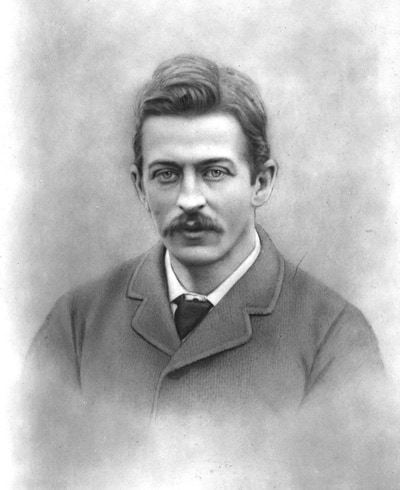
Ion Grant Neville Keith-Falconer [1856-1887] was Professor of Semitic Languages at Cambridge University.
The remarkable life of the third son of the Earl of Kintore was once familiar to many Christians, for his academic and cycle-racing prowess as well as his love of the arabs were outstanding. In 1881 whilst in Assiut in Egypt to learn colloquial Arabic, Keith-Falconer observed the work of a Presbyterian missionary, Dr Hogg. Influence, too, by discussions with General [Felix T.] Haig, and by General Gordon Gordon (of Khartoum) Keith-Falconer heard God’s call to take the Gospel to the Arabs of South Arabia, gaining access by the British Colony of Aden. In 1885 he made a four month visit to assess the situation, concluding that there was much scope for medical and educational work. He chose to make Shaykh’Uthman, twelve miles inland from Steamer Point, Aden, the base for such work which would aim to reach into the interior of the country.
Shirley A. Fraser, In the Footsteps of Ion Keith-Falconer. A brief overview of the history of the Christian Mission to South Arabia. 1998. p.2. [Brackets mine]
Although he died on malaria within six months of arriving to establish the mission in 1887… “his vision and talents inspired Samuel Zwemer and Zwemer’s brother, Peter, and Scottish and Danish recruits who took up his labors”. [Kenneth Cragg, “Keith-Falconer, Ion G(rant) N(eville),” Biographical Dictionary of Christian Missions, p.356.]
I am grateful to one of Theology on the Web’s supporters for providing a copy of this book for digitisation. This title is in the public domain.
Missiology.org.uk provides access to thousands of free articles and books on Christian missions. Here are…
The Calcutta Christian Observer was published in India between 1832 and 1862 by the Baptist…
The Rev. Andrew Fuller was a Particular Baptist who served as the minister of two…
Thomas Gillard Churcher was born in London in 1856. After finishing school he went in…
I recently uploaded the first 40 years of Charles Haddon Spurgeon's monthly magazine, The Sword…
Harold Rowdon notes that George Müller's... ...significance for world mission begins with his philanthropy. His…